Table of Content
As a result, BOOTMGR in Windows Vista and later versions replaces the functions performed by NTLDR in all Windows NT versions up to Windows XP and directly executes winload.exe, the system loader used to continue the Windows boot process. Windows Vista also does not include the Windows XP "Luna" visual theme, or most of the classic color schemes that have been part of Windows since the Windows 3.x era. The "Hardware profiles" startup feature has also been removed, along with support for older motherboard technologies like the EISA bus, APM and game port support (though on the 32-bit version game port support can be enabled by applying an older driver). The IPX/SPX protocol has also been removed, although it can be enabled by a third-party plug-in. Whereas prior releases of Windows supported per-file encryption using Encrypting File System, the Enterprise and Ultimate editions of Vista include BitLocker Drive Encryption, which can protect entire volumes, notably the operating system volume. However, BitLocker requires approximately a 1.5-gigabyte partition to be permanently not encrypted and to contain system files for Windows to boot.
However, as of May 2021, the Microsoft Update Catalog is still hosting these updates for download for Windows Vista. The Group Policy Management Console was replaced by the Group Policy Object Editor. An updated downloadable version of the Group Policy Management Console was released soon after the service pack. Computers capable of running Windows Vista are classified as Vista Capable and Vista Premium Ready.
Software
In conjunction with SuperFetch, an automatic built-in Windows Disk Defragmenter makes sure that those applications are strategically positioned on the hard disk where they can be loaded into memory very quickly with the least physical movement of the hard disk's read-write heads. While in 2005 Microsoft claimed "nearly all PCs on the market today will run Windows Vista", the higher requirements of some of the "premium" features, such as the Aero interface, affected many upgraders. According to the UK newspaper The Times in May 2006, the full set of features "would be available to less than 5 percent of Britain's PC market"; however, this prediction was made several months before Vista was released. This continuing lack of clarity eventually led to a class action against Microsoft as people found themselves with new computers that were unable to use the new software to its full potential despite the assurance of "Vista Capable" designations. The court case has made public internal Microsoft communications that indicate that senior executives have also had difficulty with this issue. For example, Mike Nash commented, "I now have a $2,100 e-mail machine" because of his laptop's lack of an appropriate graphics chip so hobbled Vista.

User Account Control, or UAC is perhaps the most significant and visible of these changes. UAC is a security technology that makes it possible for users to use their computer with fewer privileges by default, to stop malware from making unauthorized changes to the system. This was often difficult in previous versions of Windows, as the previous "limited" user accounts proved too restrictive and incompatible with a large proportion of application software, and even prevented some basic operations such as looking at the calendar from the notification tray. Regular use of the computer such as running programs, printing, or surfing the Internet does not trigger UAC prompts. User Account Control asks for credentials in a Secure Desktop mode, in which the entire screen is dimmed, and only the authorization window is active and highlighted.
Windows Vista Key Features
Users can also create "shadow copies" by setting a System Protection Point using the System Protection tab in the System control panel. The user can view multiple versions of a file throughout a limited history and be allowed to restore, delete, or copy those versions. This feature is available only in the Business, Enterprise, and Ultimate editions of Windows Vista and is inherited from Windows Server 2003. At the Intel Developer Forum on March 9, 2006, Microsoft announced a change in their plans to support EFI in Windows Vista.

A new search interface allowed for filtering of results, searching for Windows help, and natural-language queries that would be used to integrate with WinFS. The "view modes" were also replaced with a single slider that would resize the icons in real-time, in the list, thumbnail, or details mode, depending on where the slider was. File metadata was also made more visible and more easily editable, with more active encouragement to fill out missing pieces of information. Also of note was the conversion of Windows Explorer to being a .NET application. Microsoft began work on Windows Vista, known at the time by its codename "Longhorn", in May 2001, five months before the release of Windows XP. It was originally expected to ship in October 2003 as a minor step between Windows XP and "Blackcomb", which was planned to be the company's next major operating system release.
Hardware requirements
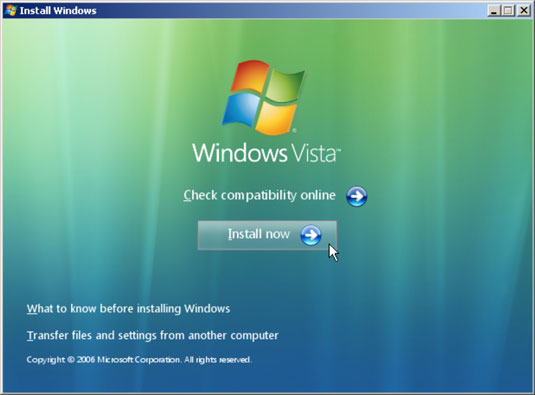
After knowing the difference between these editions, you can decide to choose which edition when installing Windows Vista. As for the product key, since the support to Vista has ended, you can search for a product key online. Improved communication between machines on a home network with peer-to-peer technology to simplify sharing files and media between computers and devices. You'll find refurbished desktop systems, running Windows 10, for about $200 US. Re-install Windows 10 onto your brand-new disk-drive, or "clone" that disk-drive onto your new disk-drive, and boot from your new disk-drive. It is possible only when installing from installation DVD of Windows Vista x64 with its service pack 1 integrated.

At a May 2009 conference, a Microsoft Vice President said "Adoption and deployment of Windows Vista has been slightly ahead of where we had been with XP" for big businesses. In July 2011, Microsoft released the Platform Update Supplement for Windows Vista and Windows Server 2008, which contains several bug fixes and performance improvements. These technologies are also available for Windows XP and Windows Server 2003 to facilitate their introduction to and usage by developers and end-users.
A Vista Capable or equivalent PC is capable of running all editions of Windows Vista although some of the special features and high-end graphics options may require additional or more advanced hardware. At the core of the operating system, many improvements have been made to the memory manager, process scheduler and I/O scheduler. The Heap Manager implements additional features such as integrity checking in order to improve robustness and defend against buffer overflow security exploits, although this comes at the price of breaking backward compatibility with some legacy applications. A Kernel Transaction Manager has been implemented that enables applications to work with the file system and Registry using atomic transaction operations. Within its first month, 20 million copies of Vista were sold, double the amount of Windows XP sales within its first month in October 2001, five years earlier. Shortly after however, due to Vista's relatively low adoption rates and continued demand for Windows XP, Microsoft decided to sell Windows XP until June 30, 2008, instead of the previously planned date of January 31, 2008.

Also, you will find that many anti-virus software programs now REFUSE to install under Vista. In addition to what the Other Person wrote, you will find that there is something wrong with Windows Update under Microsoft Vista, after Service Pack 2 is installed. The symptom is that Windows Update LITERALLY takes 7 to 10 DAYS of continuous operation to identify the required updates.
Windows Vista Starter edition is aimed at low-powered computers with availability only in emerging markets. Windows Vista Home Premium covers the majority of the consumer market and contains applications for creating and using multimedia. Windows Vista Business is specifically designed for small and medium-sized enterprises, while Windows Vista Enterprise is only available to customers participating in Microsoft's Software Assurance program. Windows Vista Ultimate contains the complete feature-set of both the Home and Business editions, as well as a set of Windows Ultimate Extras, and is aimed at enthusiasts.

New features of Windows Vista include an updated graphical user interface and visual style dubbed Aero, a new search component called Windows Search, redesigned networking, audio, print and display sub-systems, and new multimedia tools such as Windows DVD Maker. Vista aimed to increase the level of communication between machines on a home network, using peer-to-peer technology to simplify sharing files and media between computers and devices. Windows Vista included version 3.0 of the .NET Framework, allowing software developers to write applications without traditional Windows APIs. Because a release to manufacturing build is the final version of code shipped to retailers and other distributors, the purpose of a pre-RTM build is to eliminate any last "show-stopper" bugs that may prevent the code from responsibly being shipped to customers, as well as anything else that consumers may find annoying. Thus, it is unlikely that any major new features would be introduced; instead, work would focus on Vista's fit and finish. In just a few days, developers had managed to drop Vista's bug count from over 2470 on September 22 to just over 1400 by the time RC2 shipped in early October.
Service Pack 2 for Windows Vista and Windows Server 2008 was released through different channels between April and June 2009, one year after the release of Windows Vista SP1, and four months before the release of Windows 7. In addition to a number of security and other fixes, a number of new features have been added. However, it did not include Internet Explorer 8, but instead was included in Windows 7, which was released four months after Vista SP2.
Windows Media Player 11, a major revamp of Microsoft's program for playing and organizing music and video. New features in this version include word wheeling (incremental search or "search as you type"), a new GUI for the media library, photo display and organization, the ability to share music libraries over a network with other Windows Vista machines, Xbox 360 integration, and support for other Media Center Extenders. During a demonstration of the speech recognition feature new to Windows Vista at Microsoft's Financial Analyst Meeting on July 27, 2006, the software recognized the phrase "Dear mom" as "Dear aunt". After several failed attempts to correct the error, the sentence eventually became "Dear aunt, let's set so double the killer delete select all". A developer with Vista's speech recognition team later explained that there was a bug with the build of Vista that was causing the microphone gain level to be set very high, resulting in the audio being received by the speech recognition software being "incredibly distorted". Microsoft occasionally releases updates such as service packs for its Windows operating systems to fix bugs, improve performance and add new features.
Microsoft Office 2010 Service Pack 2 (64-Bit)
There were reports of Vista users "downgrading" their operating systems back to XP, as well as reports of businesses planning to skip Vista. A study conducted by ChangeWave in March 2008 showed that the percentage of corporate users who were "very satisfied" with Vista was dramatically lower than other operating systems, with Vista at 8%, compared to the 40% who said they were "very satisfied" with Windows XP. It received generally positive reviews from PC gamers who praised the advantages brought by DirectX 10, which allowed for better gaming performance and more realistic graphics, as well as support for many new capabilities featured in new GPUs.




No comments:
Post a Comment