Table of Content
A new search interface allowed for filtering of results, searching for Windows help, and natural-language queries that would be used to integrate with WinFS. The "view modes" were also replaced with a single slider that would resize the icons in real-time, in the list, thumbnail, or details mode, depending on where the slider was. File metadata was also made more visible and more easily editable, with more active encouragement to fill out missing pieces of information. Also of note was the conversion of Windows Explorer to being a .NET application. Microsoft began work on Windows Vista, known at the time by its codename "Longhorn", in May 2001, five months before the release of Windows XP. It was originally expected to ship in October 2003 as a minor step between Windows XP and "Blackcomb", which was planned to be the company's next major operating system release.
Service Pack 2 for Windows Vista and Windows Server 2008 was released through different channels between April and June 2009, one year after the release of Windows Vista SP1, and four months before the release of Windows 7. In addition to a number of security and other fixes, a number of new features have been added. However, it did not include Internet Explorer 8, but instead was included in Windows 7, which was released four months after Vista SP2.
Service Pack 2
The UEFI 2.0 specification (which replaced EFI 1.10) was not completed until early 2006, and at the time of Microsoft's announcement, no firmware manufacturers had completed a production implementation which could be used for testing. Although User Account Control is an important part of Vista's security infrastructure as it blocks software from silently gaining administrator privileges without the user's knowledge, it has been widely criticized for generating too many prompts. This has led many Vista UAC users to consider it troublesome, with some consequently either turning the feature off or putting it in auto-approval mode. Responding to this criticism, Microsoft altered the implementation to reduce the number of prompts with SP1. Though the changes resulted in some improvement, it did not alleviate the concerns completely.
In normal circumstances, the only time this partition is accessed is when the computer is booting, or when there is a Windows update that changes files in this area, which is a legitimate reason to access this section of the drive. The area can be a potential security issue, because a hexadecimal editor (such as dskprobe.exe), or malicious software running with administrator and/or kernel level privileges would be able to write to this "Ghost Partition" and allow a piece of malicious software to compromise the system, or disable the encryption. BitLocker can work in conjunction with a Trusted Platform Module cryptoprocessor (version 1.2) embedded in a computer's motherboard, or with a USB key. However, as with other full disk encryption technologies, BitLocker is vulnerable to a cold boot attack, especially where TPM is used as a key protector without a boot PIN being required too.
Windows Vista Installation Requirements
All editions except Windows Vista Starter support both 32-bit and 64-bit processor architectures. Windows Workflow Foundation provides task automation and integrated transactions using workflows. It is the programming model, engine, and tools for building workflow-enabled applications on Windows. Services for UNIX, renamed as "Subsystem for UNIX-based Applications", comes with the Enterprise and Ultimate editions of Vista.
Windows Media Player 11, a major revamp of Microsoft's program for playing and organizing music and video. New features in this version include word wheeling (incremental search or "search as you type"), a new GUI for the media library, photo display and organization, the ability to share music libraries over a network with other Windows Vista machines, Xbox 360 integration, and support for other Media Center Extenders. During a demonstration of the speech recognition feature new to Windows Vista at Microsoft's Financial Analyst Meeting on July 27, 2006, the software recognized the phrase "Dear mom" as "Dear aunt". After several failed attempts to correct the error, the sentence eventually became "Dear aunt, let's set so double the killer delete select all". A developer with Vista's speech recognition team later explained that there was a bug with the build of Vista that was causing the microphone gain level to be set very high, resulting in the audio being received by the speech recognition software being "incredibly distorted". Microsoft occasionally releases updates such as service packs for its Windows operating systems to fix bugs, improve performance and add new features.
Digital rights management
Microsoft's Trustworthy Computing initiative, which aims to improve public trust in its products, has had a direct effect on its development. This effort has resulted in a number of new security and safety features and an Evaluation Assurance Level rating of 4+. This change, announced internally to Microsoft employees on August 26, 2004, began in earnest in September, though it would take several more months before the new development process and build methodology would be used by all of the development teams. A number of complaints came from individual developers, and Bill Gates himself, that the new development process was going to be prohibitively difficult to work within.

Each was executed on a default Windows Vista installation within a standard user account. Reliability and Performance Monitor includes various tools for tuning and monitoring system performance and resources activities of CPU, disks, network, memory and other resources. Improved audio controls allow the system-wide volume or volume of individual audio devices and even individual applications to be controlled separately.
Service Pack 1 introduced support for some new hardware and software standards, notably the exFAT file system, 802.11n wireless networking, IPv6 over VPN connections, and the Secure Socket Tunneling Protocol. The "Extended Support" phase would last for the next 5 years, until April 11, 2017. Microsoft is no longer offering no-charge incident support, warranty claims, or design fixes for the operating system. For IT pros or users who needed to make specific fixes to the commercial Windows code, Microsoft required an extended hotfix agreement, which provided an additional 90 days from April 10, 2012. As part of the redesign of the network stack, Windows Firewall has been upgraded, with new support for filtering both incoming and outgoing traffic. Advanced packet filter rules can be created that can grant or deny communications to specific services.

New audio functionalities such as room correction, bass management, speaker fill, and headphone virtualization have also been incorporated. It can import from digital cameras, tag and rate individual items, adjust colors and exposure, create and display slideshows through Direct3D and burn slideshows to a DVD. This post from MiniTool Partition Wizard tells you the system requirements of Vista and gives you the Windows Vista ISO download 32-bit & 64-bit. Please don't scroll past this—the Internet Archive is growing rapidly, and we need your help. As an independent nonprofit, we build and maintain all our own systems, but we don’t charge for access, sell user information, or run ads. We'd be deeply grateful if you'd join the one in a thousand users that support us financially.
It provides the foundation for building applications and blending application UI, documents, and media content. As part of the redesign of the networking architecture, IPv6 has been fully incorporated into the operating system and a number of performance improvements have been introduced, such as TCP window scaling. Earlier versions of Windows typically needed third-party wireless networking software to work properly, but this is not the case with Vista, which includes more comprehensive wireless networking support. Official mainstream support for Vista ended on April 10, 2012, and extended support ended on April 11, 2017, while the server equivalent, Windows Server 2008, had its mainstream support ended on January 13, 2015, and extended support ended on January 14, 2020. Both versions were succeeded by Windows 7 and Windows Server 2008 R2, respectively. Unofficial methods can apply the security updates for Server 2008 to Windows Vista, because the former has a similar architecture.
Windows Communication Foundation is a service-oriented messaging subsystem that enables applications and systems to interoperate locally or remotely using Web services. The Windows Imaging Format provides the cornerstone of Microsoft's new deployment and packaging system. WIM files, which contain a HAL-independent image of Windows Vista, can be maintained and patched without having to rebuild new images. Windows Images can be delivered via Systems Management Server or Business Desktop Deployment technologies. Images can be customized and configured with applications then deployed to corporate client personal computers using little to no touch by a system administrator. Symantec used over 2,000 active malware samples, consisting of backdoors, keyloggers, rootkits, mass mailers, trojan horses, spyware, adware, and various other samples.
Gradually, "Longhorn" assimilated many of the important new features and technologies slated for Blackcomb, resulting in the release date being pushed back several times in three years. In some builds of Longhorn, their license agreement said "For the Microsoft product codenamed 'Whistler'". Many of Microsoft's developers were also re-tasked to build updates to Windows XP and Windows Server 2003 to strengthen security.
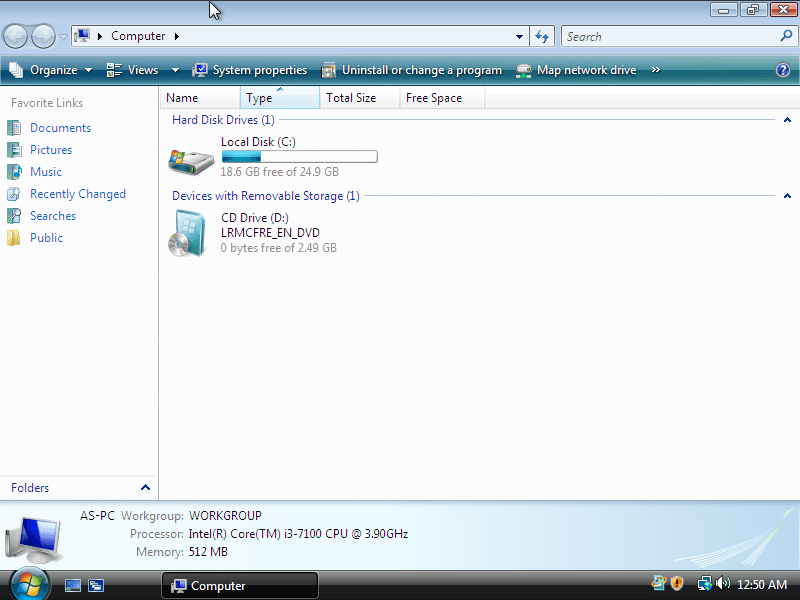
A Vista Capable or equivalent PC is capable of running all editions of Windows Vista although some of the special features and high-end graphics options may require additional or more advanced hardware. At the core of the operating system, many improvements have been made to the memory manager, process scheduler and I/O scheduler. The Heap Manager implements additional features such as integrity checking in order to improve robustness and defend against buffer overflow security exploits, although this comes at the price of breaking backward compatibility with some legacy applications. A Kernel Transaction Manager has been implemented that enables applications to work with the file system and Registry using atomic transaction operations. Within its first month, 20 million copies of Vista were sold, double the amount of Windows XP sales within its first month in October 2001, five years earlier. Shortly after however, due to Vista's relatively low adoption rates and continued demand for Windows XP, Microsoft decided to sell Windows XP until June 30, 2008, instead of the previously planned date of January 31, 2008.
Internet Archive Audio
SP1 enables support for hotpatching, a reboot-reduction servicing technology designed to maximize uptime. It works by allowing Windows components to be updated (or "patched") while they are still in use by a running process. Hotpatch-enabled update packages are installed via the same methods as traditional update packages, and will not trigger a system reboot. Areas of improvement include file copy operations, hibernation, logging off on domain-joined machines, JavaScript parsing in Internet Explorer, network file share browsing, Windows Explorer ZIP file handling, and Windows Disk Defragmenter. The ability to choose individual drives to defragment is being reintroduced as well.

Depending on what the content demands, the devices may not pass premium content over non-encrypted outputs, or they must artificially degrade the quality of the signal on such outputs or not display it at all. Drivers for such hardware must be approved by Microsoft; a revocation mechanism is also included, which allows Microsoft to disable drivers of devices in end-user PCs over the Internet. However, despite several requests for evidence supporting such claims Peter Gutmann has never supported his claims with any researched evidence. Two areas have seen changes in SP1 that have come as the result of concerns from software vendors. One of these is desktop search; users will be able to change the default desktop search program to one provided by a third party instead of the Microsoft desktop search program that comes with Windows Vista, and desktop search programs will be able to seamlessly tie in their services into the operating system. These changes come in part due to complaints from Google, whose Google Desktop Search application was hindered by the presence of Vista's built-in desktop search.




No comments:
Post a Comment